
Passing wealth on to the next generation is one of the most important decisions a family faces. When it is not planned, succession in Colombia can take years, paralyze companies and strain family relationships. When it is planned in advance, it makes it possible to carry out the founder’s wishes, protect the heirs and keep the businesses going. This guide explains the basic rules of succession, its tax effects, and the succession planning tools available.
Note: This article was published on October 15, 2026 and reflects the regulations in force on that date. Rules can change; please speak with our team before making any decision.
How succession works in Colombia
Succession on death is governed mainly by Book Three of the Colombian Civil Code (Código Civil, or CC). When a person dies, their estate (assets, rights and debts) passes to their heirs and legatees, either as set out in a will or, if there is none, under the rules of the law.
Testate and intestate succession
- Testate: there is a valid will that distributes the assets, always within the limits set by law.
- Intestate: there is no will, or it is ineffective, and the law determines who inherits and in what proportion.
Orders of inheritance
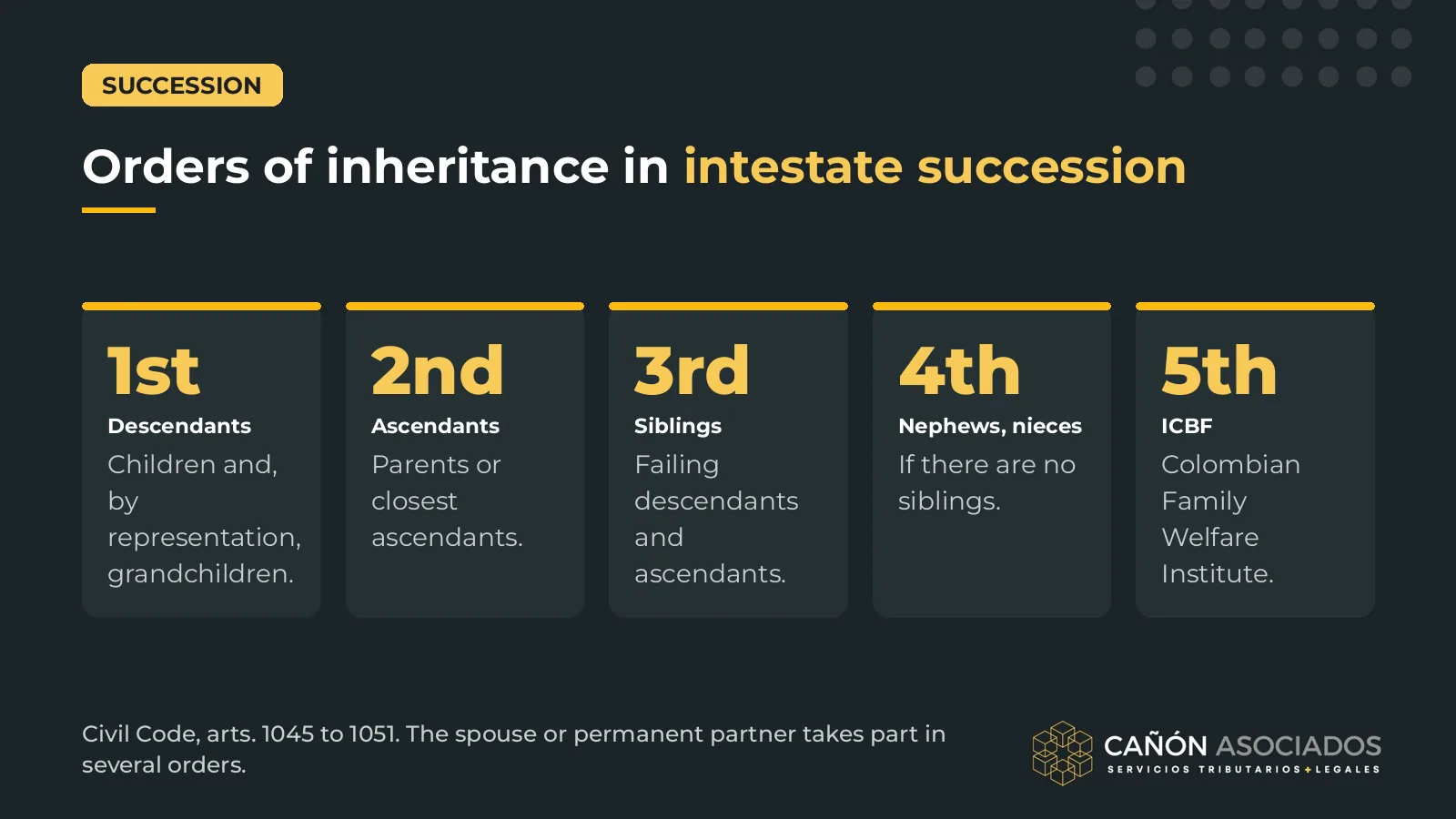
In intestate succession, the Civil Code (arts. 1045 to 1051) establishes orders that exclude one another: first the descendants; failing them, the closest ascendants; then siblings; then nephews and nieces; and finally the Colombian Family Welfare Institute (ICBF). The surviving spouse takes part in several of these orders and may be entitled to the spousal portion (porción conyugal), and constitutional case law has extended these rights to the permanent partner (compañero permanente, an unmarried partner in a stable union).
Before the estate is divided, the marital or partnership property regime must be liquidated: the surviving spouse or partner receives their share of the community property (gananciales), which is not part of the inheritance.
Forced heirship and freedom to make a will
In Colombia, freedom to dispose of assets by will is limited. Forced heirship shares (legítimas) are mandatory allocations in favor of the forced heirs, who are the descendants and, failing them, the ascendants (art. 1240 CC). Since Law 1934 of 2018, in force from January 1, 2019, when there are forced heirs half of the estate goes to the strict forced share and the other half is freely disposable (art. 1242 CC). The law eliminated the former “improvement quarter” (cuarta de mejoras), although wills deposited with a notary before the law took effect remain governed by the earlier regime.
If a will disregards the forced shares, those affected can bring an action to reform the will (art. 1274 CC).
The succession process: notarial or judicial
Notarial succession
Governed by Decree 902 of 1988, it is available when all the heirs, legatees and the surviving spouse or partner act by mutual agreement, through a lawyer. It is usually the fastest and most private route.
Judicial succession
It is conducted before the family or civil judge, depending on the amount involved, under articles 487 and following of the General Procedure Code (Código General del Proceso). It is necessary when there are disagreements or disputes over inventories, valuations or who qualifies as an heir. It can take several years, during which the assets remain in the undivided estate.
Taxes in succession
There is no separate “inheritance tax” in Colombia, but succession does have significant tax effects:
- Occasional gains tax: what heirs and legatees receive is taxed as an occasional gain (ganancia ocasional) at 15% (art. 314 of the Colombian Tax Code, or ET, as amended by Law 2277 of 2022).
- Exemptions (art. 307 ET): the first 13,000 UVT of the decedent’s primary residence; the first 6,500 UVT of other real estate; the first 3,250 UVT of what each heir, legatee or spouse receives; and 20% of what is received by persons other than forced heirs, capped at 1,625 UVT. (The UVT is the tax value unit Colombia updates every year.)
- Undivided estate: until it is liquidated, it is an income taxpayer and may be subject to the net wealth tax (art. 292-3 ET).
- Life insurance: payouts are taxed as an occasional gain to the extent they exceed 3,250 UVT (art. 303-1 ET).
Proper tax planning makes it possible to quantify these effects and anticipate the liquidity needed to cover them.
Common causes of succession disputes
- No will, or wills that are out of date with family reality (new children, divorces, second unions).
- Disregard of forced shares, which leads to claims to reform the will.
- Indivisible assets such as family companies or properties that several heirs must share without clear rules.
- Lack of information: heirs who do not know the existing assets, debts or structures, including those abroad.
- Companies without a succession plan, where it is not defined who will lead and how decisions will be made.
- Lack of liquidity to pay taxes, debts and the costs of the process.
Succession planning tools
Succession planning combines several tools that must be coordinated with one another:
Will
It is the foundation of any plan. It lets you dispose of the freely disposable half, appoint an executor and set out the division of assets. Its formalities are explained in our guide to wills in Colombia.
Division of assets during life
Article 1375 of the Civil Code allows a person to divide their assets by an act between living persons or by will, as long as the rights of others are not harmed, in particular the forced shares.
Gifts
They allow assets to be transferred during life. Gifts above 50 monthly minimum wages require prior notarial approval (insinuación, Decree 1712 of 1989) and generate an occasional gain for the recipient. They must be taken into account when calculating the forced shares.
Companies and the family holding company
Concentrating assets in a company means heirs inherit a shareholding rather than individual assets, and allows rules on management and transfer to be set through the bylaws and shareholders’ agreements. See our guide to the family holding company.
Fiducia mercantil (commercial trust)
It allows assets to be set apart in an independent estate administered by a licensed trust company, with instructions on how they are managed and where they go, always respecting forced allocations.
Family protocol and corporate governance
It sets rules on ownership, management, employment of relatives, dividends and conflict resolution, and gives the family business continuity beyond the succession.
The family business and assets abroad
Two situations deserve special attention. The first is the family business: if shares are divided among heirs without prior rules, there can be deadlock in the shareholders’ meeting, disputes over dividends, or the entry of unwanted third parties. The bylaws, shareholders’ agreements and family protocol should provide who leads, how shares are valued, and under what conditions they can be sold.
The second is assets abroad. Accounts, real estate or companies outside Colombia may be subject to the succession rules and taxes of other countries, in addition to Colombian obligations to report assets held abroad. For structures such as trusts or foundations, article 295-3 of the ET contains special rules on who must declare them for net wealth tax purposes, even after the settlor’s death. Coordinating these jurisdictions in advance avoids parallel proceedings and unnecessary costs.
Recommendations for starting your succession planning
- Draw up a complete inventory of assets, liabilities and structures, in Colombia and abroad.
- Define your objectives: protection of your spouse, equal or differentiated treatment of heirs, continuity of the business.
- Review your marital property regime with your spouse or partner, and the effect of prenuptial agreements or earlier unions.
- Quantify the taxes and the liquidity needed for the succession.
- Coordinate the tools (will, companies, fiducia, protocol) into one coherent plan.
- Review the plan periodically, whenever family, asset or regulatory circumstances change.
How Cañón Asociados can help
Succession planning is at the heart of our family wealth management practice. We organize families’ assets before a death occurs, with structures that protect family unity and the continuity of their businesses. With Integra Family Office we also support the administration and compliance of the family companies once the structure is in place. Our managing partner, Carlos Andrés Cañón, is recognized by Chambers High Net Worth in Private Wealth Law – Colombia, among other international rankings.
Keep reading
Frequently asked questions
How much can I leave freely in my will if I have children?
For wills governed by Law 1934 of 2018, half of the estate is the strict forced share of the forced heirs and the other half is freely disposable. Debts, expenses and, where applicable, the spousal portion must be deducted first.
How long does a succession take in Colombia?
It depends on the route. A notarial succession, when the interested parties agree, is usually resolved in a matter of months. A judicial one can take several years if there are disputes.
Do heirs pay taxes on an inheritance?
Yes. What they receive is taxed as an occasional gain at 15%, with the exemptions of article 307 of the ET, such as the first 3,250 UVT for each heir and the first 13,000 UVT of the decedent’s primary residence.
Is the spouse an heir?
The spouse is not a forced heir, but receives their share of the community property when the marital regime is liquidated, takes part in some orders of inheritance, and may be entitled to the spousal portion. Case law has recognized similar rights for the permanent partner.
What happens if a person dies without a will?
The estate is distributed according to the orders of inheritance in the Civil Code. This may not match the decedent’s wishes and increases the risk of conflict.
Plan ahead for the continuity of your wealth and your family.
Our wealth management team will help you design a succession plan that fits your goals, with legal certainty and tax efficiency.
- Chambers High Net Worth
- Legal 500 · ITR World Tax
- Leaders League · Best Lawyers
Contact our team directly
Carlos Andrés CañónManaging Partnercarlos.canon@canonasociados.com Carolina AcostaPartner, Legal Departmentcarolina.acosta@canonasociados.com
 Cañón AsociadosCalle 99 # 7A-77, Bogotá · contacto@canonasociados.com601 880 4462601 691 8313310 801 3324