

The 2026 net wealth tax in Colombia (impuesto al patrimonio) is once again a central issue for business families and high-net-worth individuals with ties to the country. On top of the permanent regime created by Law 2277 of 2022, this year brought a one-off tax on legal entities issued under a declared state of emergency, and bills are now moving through Congress that could change the tax from 2027. This guide explains who must pay it, how the taxable base is determined, what the rates are, and what is worth reviewing before January 1, 2027.
Note: This article was published on October 15, 2026 and reflects the regulations in force on that date. Rules can change; please speak with our team before making any decision.
What the net wealth tax is in Colombia
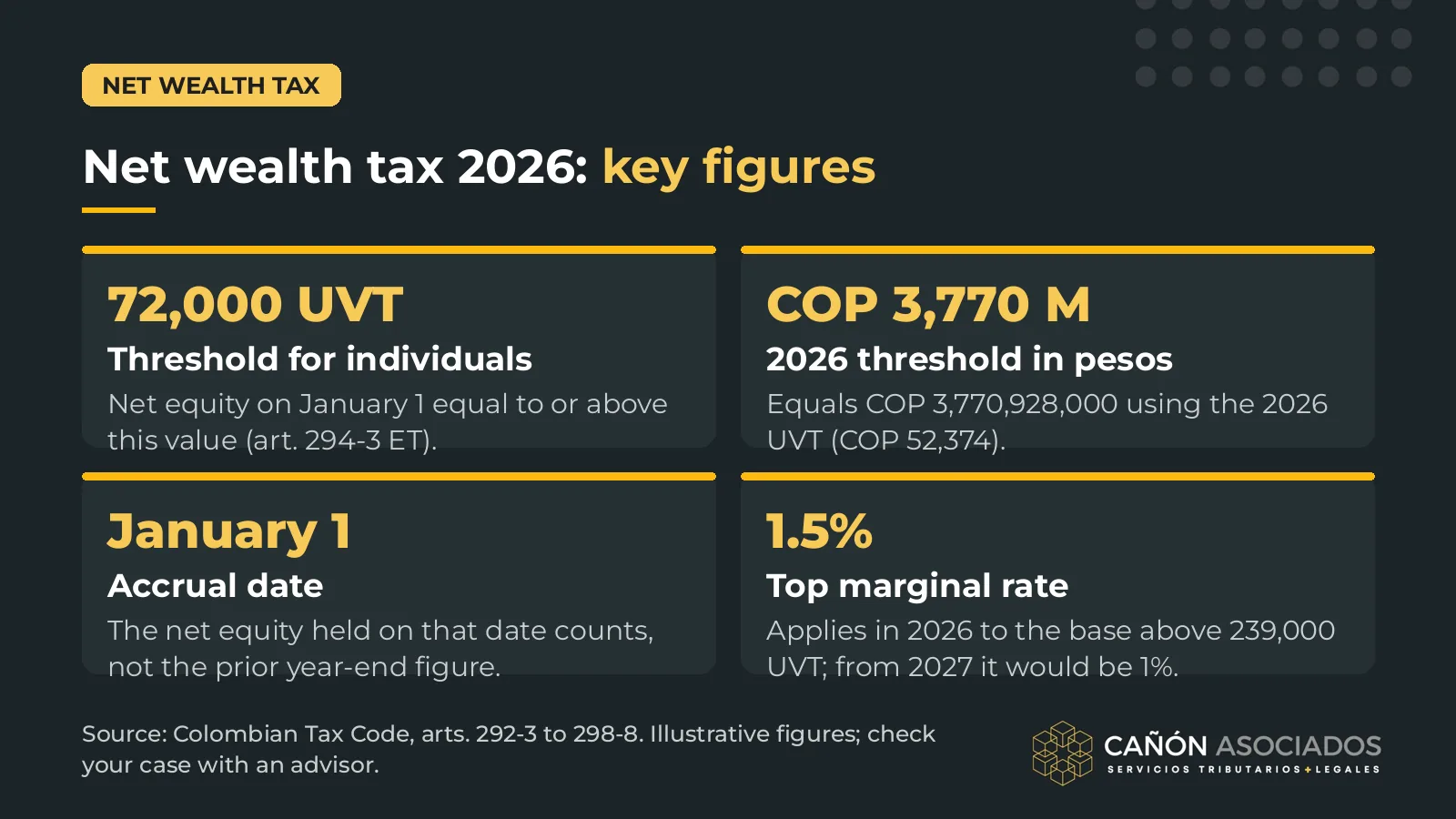
It is a national tax on the ownership of wealth, not on income. It is governed by articles 292-3 to 298-8 of the Colombian Tax Code (Estatuto Tributario, or ET) and, since Law 2277 of 2022, it is permanent for individuals. It accrues on January 1 of each year: what matters is your net equity (patrimonio líquido, meaning gross assets minus debts) on that date, not the figure at the end of the previous year. The tax is also neither deductible nor creditable against income tax (art. 297-3 ET).
Who must pay the 2026 net wealth tax
Individuals and undivided estates
Under article 292-3 of the ET, the taxpayers are individuals and undivided estates (sucesiones ilíquidas) that are subject to income tax or to its substitute regimes. The tax arises when net equity on January 1 is equal to or greater than 72,000 UVT (art. 294-3 ET). The UVT is the tax value unit that Colombia updates each year; for 2026 it was set at COP 52,374 by DIAN Resolution 000238 of 2025, which puts the threshold at COP 3,770,928,000.
Non-residents and foreign entities
Individuals who are not Colombian tax residents are also taxpayers, on the wealth they hold in Colombia directly or through permanent establishments, as are the undivided estates of non-resident decedents. Foreign companies or entities that do not file income tax in Colombia are caught when they hold assets in the country other than shares, receivables or portfolio investments, such as real estate, yachts, works of art or aircraft, provided those investments comply with the foreign exchange regime.
Legal entities: the one-off 2026 tax
The 2026 net wealth tax for legal entities is different from the ordinary regime. It was created by Legislative Decree 0173 of 2026, issued under the state of emergency declared by Legislative Decree 0150 of 2026, and applies only to the 2026 tax year. Its main features were:
- Taxpayers: legal entities and de facto companies that file income tax returns, with some exclusions (for example, companies in the health sector and entities under government intervention).
- Taxable event: net equity equal to or greater than 200,000 UVT (COP 10,474,800,000) on March 1, 2026.
- Rates: 0.5% in general and 1.6% for financial institutions, insurers, stockbrokers, securities market infrastructure providers, and coal and crude oil extraction companies.
- Payment: return and first installment on April 1, second installment on May 4, 2026. Legislative Decree 0240 of 2026 extended the tax to permanent establishments and branches of foreign entities, with their own deadlines.
The Constitutional Court, through Order 533 of 2026, provisionally suspended collection of the second installment for non-profit entities under the special tax regime and for legal entities in liquidation. At the time of writing, the constitutional review of Decree 0173 is still pending, so its outcome may affect amounts already paid.
It is important not to confuse this tax with Legislative Decree 1474 of 2025, which sought to change the net wealth tax from January 1, 2026. The Court suspended its effects in January and later struck it down (Judgment C-079 of 2026), ordering that direct taxes accrued under that decree not be declared or collected. As a result, individuals remained subject to the Law 2277 of 2022 regime in 2026.
How the taxable base is calculated
The taxable base is gross wealth held on January 1 minus the debts outstanding on that date, valued under the general rules of Title II of Book I of the ET, with the special rules of article 295-3.
Exclusion of the primary residence
Individuals may exclude the first 12,000 UVT (COP 628,488,000 in 2026) of the book value of the house or apartment where they actually live most of the time. The exclusion does not cover vacation properties or second homes, and it is calculated in proportion to the ratio between net equity and gross wealth.
Shares, trust rights and offshore structures
- Unlisted shares: taken at their adjusted tax cost (art. 73 ET); if that figure exceeds intrinsic value, intrinsic value is used.
- Listed shares: at the average trading price of the year before the accrual date.
- Trusts and funds: rights are valued under article 271-1 of the ET, looking at the underlying assets.
- Private interest foundations, trusts, savings-linked insurance and other offshore vehicles: treated like trust rights and, where the beneficiaries have no control over or power to dispose of the assets, the person who declares is the settlor or founder, regardless of whether the structure is discretionary or irrevocable.
Because of these rules, the way your wealth is organized has a direct effect on the taxable base, which is why tax planning needs sound technical judgment and solid documentation.
2026 rates and what changes from 2027
Article 296-3 of the ET sets marginal rates: each rate applies only to the portion of the base that falls within its bracket.
| Taxable base (UVT) | Marginal rate | Tax |
|---|---|---|
| Up to 72,000 | 0% | 0 |
| Over 72,000 up to 122,000 | 0.5% | (Base − 72,000) × 0.5% |
| Over 122,000 up to 239,000 | 1.0% | (Base − 122,000) × 1.0% + 250 UVT |
| Over 239,000 | 1.5% | (Base − 239,000) × 1.5% + 1,420 UVT |
The paragraph of article 296-3 provides that the 1.5% rate applies temporarily in 2023, 2024, 2025 and 2026. Under the current rule, from 2027 the top marginal rate will be 1% on the base exceeding 122,000 UVT.
Illustrative example. With a taxable base of 300,000 UVT on January 1, 2026, the tax would be (300,000 − 239,000) × 1.5% + 1,420 = 2,335 UVT, or about COP 122.3 million. Under the table scheduled for 2027, the same base would produce 2,030 UVT.
Filing and payment dates in 2026
For individuals, the return and first installment fell due between May 12 and 26, 2026, depending on the last digit of the taxpayer ID (NIT), and the second installment was due on September 14, 2026. You can find the other deadlines in our 2026 Colombian Tax Calendar. A taxpayer who was required to file and did not must do so with a late-filing penalty (art. 641 ET) and default interest on amounts not paid on time.
What is under discussion for 2027
At the time of writing, two opposing positions coexist. Bill 004 of 2026 (House), filed on July 20, 2026, proposes lowering the threshold for individuals to 40,000 UVT and setting marginal rates between 0.5% and 5% from 2027. The national government, for its part, has announced its intention to submit an initiative that would phase the tax out. Neither proposal is law, so the Law 2277 of 2022 regime remains in force today, and any decision about your assets should be tested against alternative scenarios.
Recommendations before January 1, 2027
- Project your net equity on January 1, 2027 using tax values, not market values, and identify which bracket you would fall into under each regulatory scenario.
- Check the support for your debts. Only real, properly documented liabilities are deducted; DIAN can disregard those without adequate backing.
- Review how your holdings are valued in companies, trusts and offshore vehicles under article 295-3 of the ET.
- Avoid transactions without an economic purpose. Reorganizations carried out only to reduce the tax can be challenged under the general anti-abuse rule (art. 869 ET).
- Build the tax into your wealth planning: liquidity to pay it, its impact on succession, and consistency with the family structure.
How Cañón Asociados can help
At Cañón Asociados we combine tax advice with the wealth management of families and companies. Our managing partner, Carlos Andrés Cañón, is recognized by Chambers High Net Worth in Private Wealth Law – Colombia, and the firm is ranked by ITR World Tax, Legal 500, Leaders League and Best Lawyers. We analyze your specific situation, quantify the impact of the tax under the different scenarios, and design alternatives with legal certainty.
Keep reading



Frequently asked questions
From what amount is the net wealth tax payable in Colombia in 2026?
Individuals pay it if their net equity on January 1, 2026 was equal to or greater than 72,000 UVT, equivalent to COP 3,770,928,000 using the 2026 UVT (COP 52,374).
Do legal entities pay net wealth tax in 2026?
Yes, on a one-off basis. Legislative Decree 0173 of 2026 taxed legal entities and de facto companies with net equity equal to or greater than 200,000 UVT on March 1, 2026, at a general rate of 0.5%. Its constitutionality is still pending a decision on the merits.
Does the 1.5% rate apply to all of my wealth?
No. The rates are marginal: 1.5% applies only to the portion of the base that exceeds 239,000 UVT. Under article 296-3 of the ET, 2026 is the last year of that rate.
How much of my home is excluded from the taxable base?
The first 12,000 UVT of the book value of the house or apartment where the person actually lives most of the time. It does not apply to vacation properties or second homes.
Can the net wealth tax be deducted on the income tax return?
No. Article 297-3 of the ET provides that it is neither deductible nor creditable against income tax, and it cannot be offset against other taxes.
Is your wealth above, or close to, the tax threshold?
Our tax planning and wealth management team can project your position as of January 1, 2027 and propose alternatives suited to your family and your businesses.
- Chambers High Net Worth
- Legal 500 · ITR World Tax
- Leaders League · Best Lawyers
Contact our team directly
Carlos Andrés CañónManaging Partnercarlos.canon@canonasociados.com Carolina AcostaPartner, Legal Departmentcarolina.acosta@canonasociados.com
 Cañón AsociadosCalle 99 # 7A-77, Bogotá · contacto@canonasociados.com601 880 4462601 691 8313310 801 3324