

A will is the most direct tool for deciding how your assets will be distributed and for keeping the law from deciding for you. Yet many families put it off, or sign one without advice, which leads to disputes, delays and costs that could have been avoided. This guide explains what a will in Colombia is, what types exist, what the requirements are, and which mistakes to avoid.
Note: This article was published on October 15, 2026 and reflects the regulations in force on that date. Rules can change; please speak with our team before making any decision.
What a will is
Article 1055 of the Colombian Civil Code (Código Civil, or CC) defines it as a more or less solemn act in which a person disposes of all or part of their assets so that it takes full effect after their death, while keeping the power to revoke their provisions during their lifetime. Three key characteristics follow from this definition:
- It is personal: it cannot be made through an attorney-in-fact or jointly with another person (arts. 1059 and 1060 CC).
- It is solemn: its validity depends on strict compliance with the legal formalities.
- It is revocable: you can change or revoke it at any time by making a new will (arts. 1057 and 1270 CC).
Who can make a will
Anyone whom the law does not declare unfit may make a will. Article 1061 of the Civil Code lists as unfit, among others, those who are not of sound mind when making it and those who cannot express their wishes clearly. Capacity is assessed at the moment the will is made, so it is advisable to record the testator’s state of lucidity, especially for older people or those with illnesses.
Types of will in Colombia
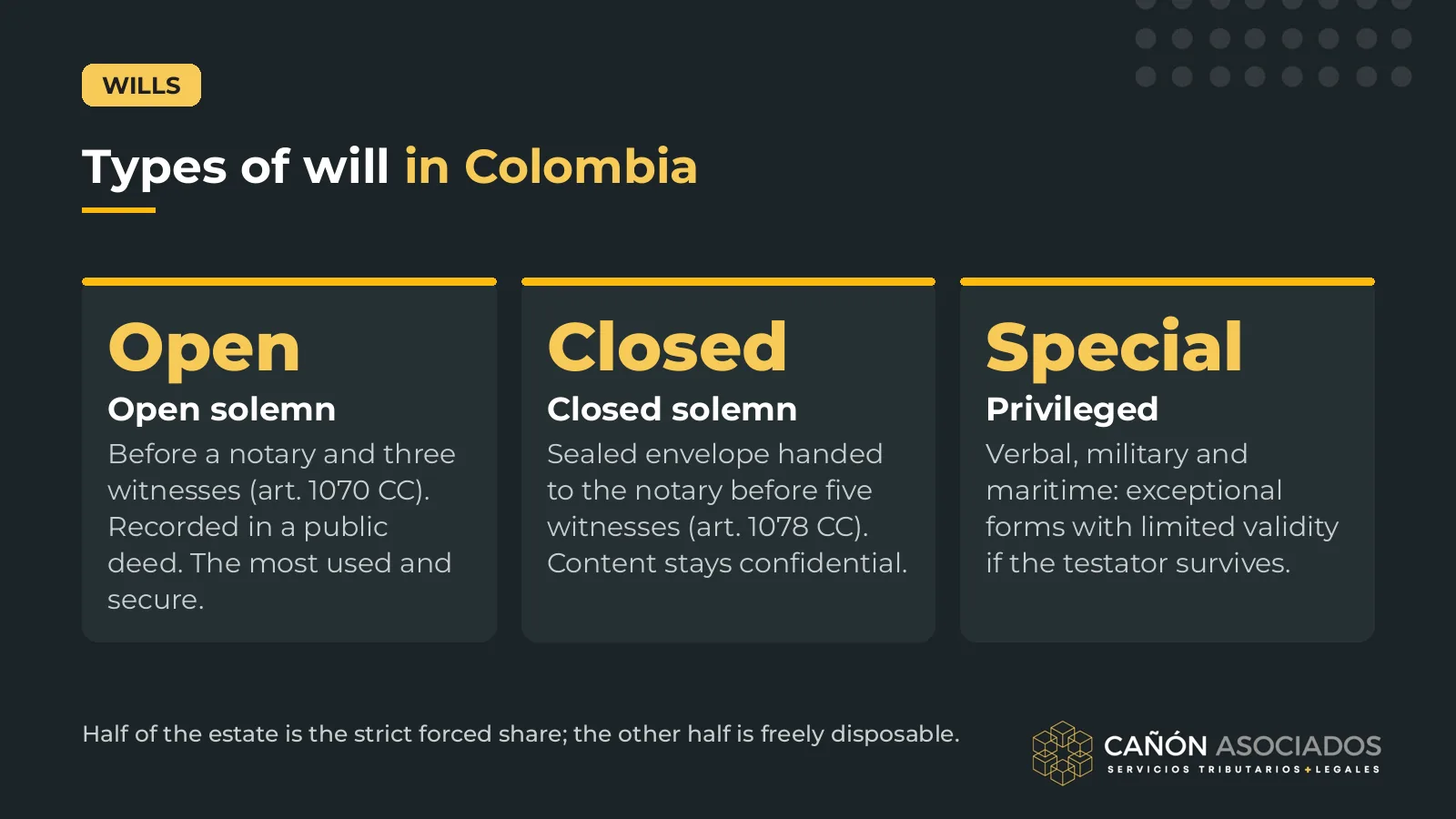
Open solemn will
This is the most widely used. It is made before a notary and three witnesses (art. 1070 CC), who must be present throughout the act. The testator makes their provisions known, and they are recorded in a public deed. Where there is no notary, it can be made before five witnesses, with additional requirements (art. 1071 CC).
Advantages: greater legal certainty, lower risk of loss and simpler execution.
Closed solemn will
The testator hands the notary a sealed envelope in the presence of five witnesses and declares aloud that it contains their will (art. 1078 CC). The content stays confidential until it is opened, which takes place before a notary or judge after the death.
Advantages: confidentiality of the content. Risks: if the formalities for sealing and opening are not met, it may be ineffective.
Privileged wills
The Civil Code provides exceptional forms, with reduced formalities, for special situations: the verbal will in imminent danger of death (arts. 1092 and following), the military will and the maritime will. They have limited validity if the testator survives, so they do not replace an ordinary will.
Wills made abroad
A will made outside Colombia can have effect in the country if it complies with the form required by the law of the place where it was made and with the conditions of article 1084 of the Civil Code. For families with assets or residence in several countries, it is essential to coordinate wills to avoid contradictions or unintended revocations.
It is worth remembering that Colombia does not recognize the holographic will, that is, one written in the testator’s own hand without the legal formalities.
What you can and cannot provide for in your will
Freedom to make a will is limited by mandatory allocations: maintenance owed by law, the spousal portion (porción conyugal) and forced heirship shares (legítimas) (art. 1226 CC). Where there are forced heirs (descendants or, failing them, ascendants), since Law 1934 of 2018:
- Half of the estate is the strict forced share and is divided among the forced heirs under the rules of intestate succession.
- The other half is freely disposable, and can be left to anyone, including the spouse, one of the children or third parties.
Wills deposited with a notary before January 1, 2019 remain governed by the earlier regime, which included the “improvement quarter” (cuarta de mejoras).
Besides distributing assets, a will allows you to:
- Appoint an executor (albacea) (arts. 1327 and following CC).
- Make the division of the assets (art. 1375 CC).
- Name guardians for minor children.
- Acknowledge children.
- Disinherit a forced heir, only on the exhaustive grounds in article 1266 of the Civil Code.
Common mistakes when making a will
- Not updating it. Marriages, divorces, births, deaths or the sale of significant assets can leave a will out of step with reality.
- Disregarding forced shares. Leaving a third party or a single child more than is allowed opens the door to an action to reform the will (art. 1274 CC).
- Disposing of assets that are not yours. If a marital or partnership property regime is in force, the testator can only dispose of what is theirs once it is liquidated; the spouse’s share of community property is not part of the inheritance.
- Vague descriptions of assets. Imprecise references lead to conflicting interpretations among heirs.
- Ignoring the corporate structure. Many families hold their assets in companies; what is inherited is shares or ownership interests, and the bylaws or shareholders’ agreements may restrict their transfer.
- Not considering taxes. What heirs and legatees receive is taxed as an occasional gain at 15% (art. 314 of the Colombian Tax Code, or ET), with the exemptions of article 307 of the ET. A distribution that does not provide the necessary liquidity may force assets to be sold.
- Leaving out assets abroad. They may require additional wills or proceedings in other jurisdictions.
- Defects of form. The absence of a witness during the act, or unfit witnesses (art. 1068 CC), can affect the validity of the will.
How to prepare your will step by step
- Gather your asset information. An inventory of real estate, shareholdings, accounts, investments and debts, in Colombia and abroad, with the documents proving ownership.
- Review your family and financial situation. Identify your forced heirs, the regime of your marriage or partnership, and any earlier prenuptial agreements or unliquidated marital property.
- Define your objectives. Decide how you want to distribute the freely disposable half, whether you want to give special protection to a relative, and how to secure the continuity of the family business.
- Validate the tax effects. Estimate the occasional gain each heir will receive and the liquidity available to cover it.
- Draft with precision. Identify the assets clearly, appoint an executor and, if appropriate, include the division of assets.
- Make the will with the legal formalities. Check that the witnesses are eligible and are present throughout the act.
- Schedule periodic reviews. Review the will whenever there is a relevant change in family, assets or regulation.
The will within an integrated succession plan
A will is indispensable, but rarely sufficient on its own. For complex estates it must be coordinated with other tools: companies or a family holding company, fiducia mercantil, a family protocol, shareholders’ agreements and insurance. You can learn about the full process in our guide to succession planning in Colombia and in our family wealth management practice.
It is also advisable to review the tax impact of each decision with our tax planning and consulting team, especially regarding occasional gains, the net wealth tax on the undivided estate, and assets abroad.
How Cañón Asociados can help
In our family wealth management practice we draft wills that precisely reflect the testator’s wishes and fit into a coherent succession structure. We review forced shares, marital property regime, corporate structure and tax implications before the will is signed. Our managing partner, Carlos Andrés Cañón, is recognized by Chambers High Net Worth in Private Wealth Law – Colombia, and the firm is ranked by Legal 500, Leaders League, ITR World Tax and Best Lawyers.
Keep reading

Frequently asked questions
How many witnesses are needed for an open will in Colombia?
Three witnesses, in addition to the notary (art. 1070 CC). If there is no notary in the place, five witnesses are required. A closed will requires a notary and five witnesses.
Can I leave all my assets to one person?
Only if you have no forced heirs (descendants or ascendants). If you do, half of the estate is the strict forced share and you can freely dispose of only the other half.
Can a will be changed?
Yes. A will is essentially revocable. It can be modified or revoked in whole or in part by a new will made with the legal formalities.
Is a handwritten will valid?
No. Colombia does not recognize the holographic will. To be valid, it must be made with the formalities of an open, closed or one of the privileged wills.
Does a will avoid the succession process?
No. Even with a will, the succession must still be carried out, whether notarial or judicial. However, a well-drafted will reduces disputes and makes for a faster process.
Make sure your wishes are carried out and your family is protected.
Our wealth management team will help you prepare your will and integrate it into a complete succession plan.
- Chambers High Net Worth
- Legal 500 · ITR World Tax
- Leaders League · Best Lawyers
Contact our team directly
Carlos Andrés CañónManaging Partnercarlos.canon@canonasociados.com Carolina AcostaPartner, Legal Departmentcarolina.acosta@canonasociados.com
 Cañón AsociadosCalle 99 # 7A-77, Bogotá · contacto@canonasociados.com601 880 4462601 691 8313310 801 3324