

When a family’s wealth includes several companies, properties and investments, holding all of those assets in the names of individuals tends to create disorder, risk and difficulties at succession. The family holding company is one of the tools most used in Colombia to organize ownership, centralize decisions and make it easier to pass wealth between generations. This article explains what it is, what its tax and asset protection advantages are, how it is set up, and what risks need to be assessed.
Note: This article was published on October 15, 2026 and reflects the regulations in force on that date. Rules can change; please speak with our team before making any decision.
What a family holding company is
A family holding company is a company whose shareholders are members of a family and whose main activity is to hold and manage interests in other companies and other assets of the family group. Instead of each member owning the operating companies, properties or portfolios directly, the family owns the holding company and the holding company owns the assets.
In Colombia, the most widely used vehicle is the simplified stock company (SAS, sociedad por acciones simplificada), governed by Law 1258 of 2008, because of its flexible bylaws and the limited liability of its shareholders.
It should not be confused with the Colombian Holding Company (CHC) regime in articles 894 to 898 of the Colombian Tax Code (Estatuto Tributario, or ET), a special regime designed for companies with investments in foreign entities that requires specific substance requirements to be met.
Advantages of a family holding company
Order and control of ownership
The holding company concentrates ownership of the group in a single entity, which makes decision-making, consolidated reporting and dealings with banks, investors and authorities easier. It also allows ownership to be separated from management: the family decides at the holding company’s shareholders’ meeting, and the operating companies keep their own professional management.
Continuity and succession planning
When a founder dies, their heirs receive shares of the holding company rather than a multitude of individual assets. This reduces the risk that companies or properties are fragmented or tied up in succession proceedings. The bylaws of an SAS allow you to establish:
- Restrictions on share transfers for up to ten years, renewable (art. 13 of Law 1258 of 2008).
- Pre-emption rights and prior approvals for the entry of third parties.
- Share classes with multiple votes, preferred dividends or no voting rights (art. 10 of Law 1258 of 2008), useful for distinguishing those who manage from those who only invest.
- Grounds for expelling shareholders (art. 39 of Law 1258 of 2008).
These rules are complemented by shareholders’ agreements (art. 24 of Law 1258 of 2008) and by the family protocol.
Asset protection
In an SAS, shareholders are liable up to the amount of their contributions (art. 1 of Law 1258 of 2008). A well-designed structure makes it possible to separate assets of different risk: for example, keeping the family’s real estate in a different company from the operating business, so that the risks of the operation do not directly compromise the real estate wealth.
This protection has limits: the law allows the corporate veil to be disregarded when the company is used to defraud the law or to harm third parties (art. 42 of Law 1258 of 2008), and creditors can challenge transfers made to defraud them. That is why asset protection must be planned in advance and for legitimate purposes.
Tax efficiency
A holding company is not, in itself, a way to pay less tax, but it does allow more orderly tax management:
- Contributions in kind without income tax effects. Contributions of assets to Colombian companies do not generate taxable income or count as a sale if the requirements of article 319 of the ET are met: the company keeps the tax cost of the assets and the shares received take that same tax cost.
- Dividend management. Dividends that one Colombian company distributes to another are subject to a transferable withholding (art. 242-1 ET) that is credited when they are finally distributed to individuals. This allows profits to be reinvested within the group and the timing of distributions to shareholders to be chosen, with shareholders taxed under articles 242 and 254-1 of the ET.
- Reorganizations. It facilitates mergers and spin-offs under the neutrality rules of articles 319-3 to 319-6 of the ET, when their conditions are met.
- Valuation for the net wealth tax. Unlisted shares are declared at their adjusted tax cost or at their intrinsic value, whichever is lower (art. 295-3 ET). How the wealth is structured therefore affects the taxable base.
Each of these effects must be analyzed with our tax planning and consulting team, since it depends on the family’s specific circumstances.
How a family holding company is set up
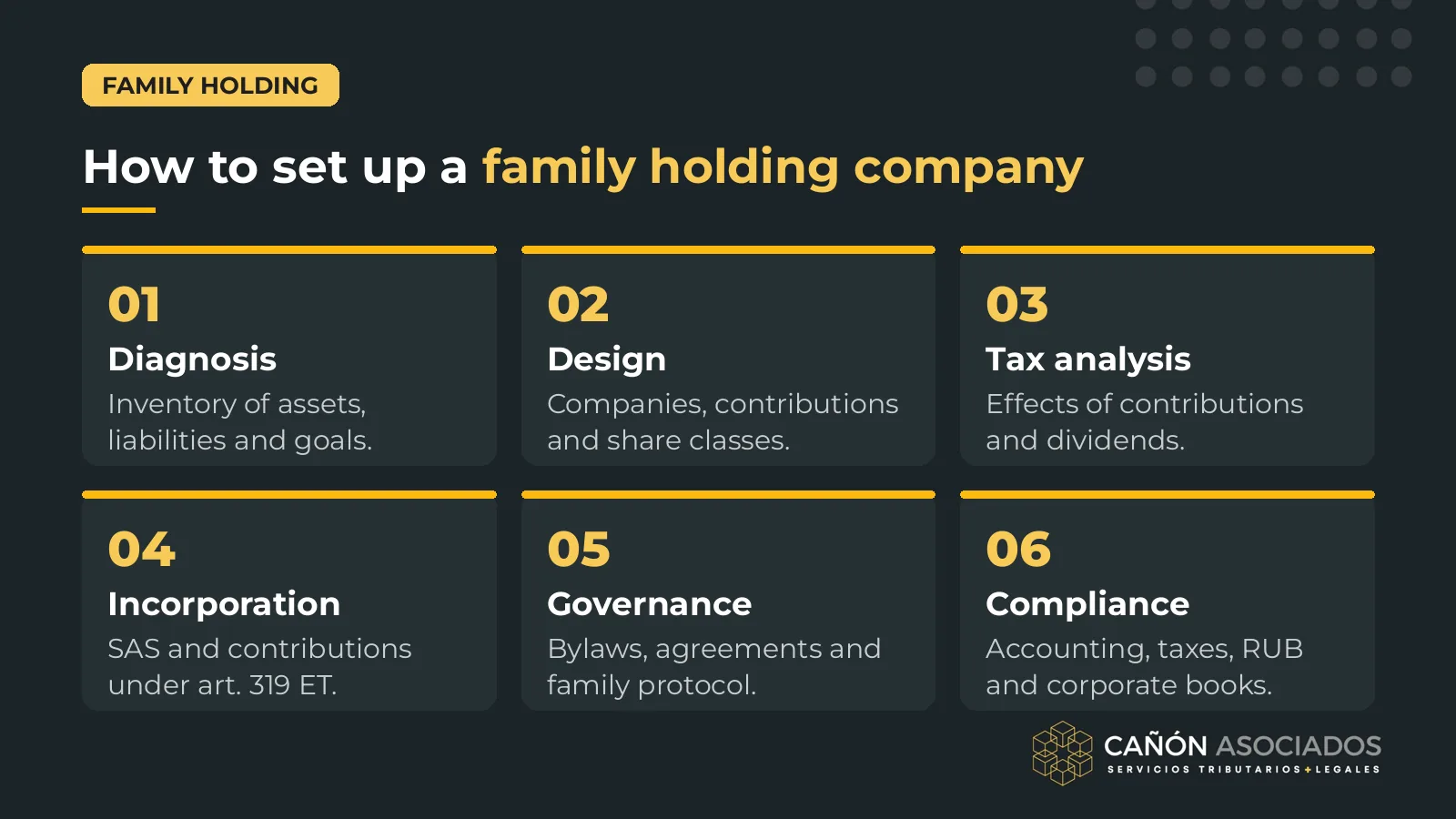
- Asset diagnosis: inventory of assets, liabilities, current structure and the family’s objectives.
- Structure design: number of companies, assets to be contributed, share classes and governance rules.
- Tax analysis: quantifying the effects of the contribution, of holding the assets and of future dividend distributions, including indirect taxes and notarial and registration costs.
- Incorporation and contributions: the SAS incorporation document, contribution of assets meeting the requirements of article 319 of the ET, and the corresponding registrations, including public deeds for real estate.
- Corporate governance: bylaws, shareholders’ agreements, family protocol and internal rules.
- Ongoing compliance: accounting, tax returns, the Ultimate Beneficial Owner Registry (RUB), corporate books and reports.
Our commercial and corporate law team supports the incorporation, bylaw amendments and corporate management of these structures.
Risks and aspects to assess
- Tax abuse. DIAN, the Colombian tax authority, can recharacterize transactions that lack a commercial or economic purpose and whose main aim is to obtain a tax benefit (art. 869 ET). The holding company must have business and family reasons that justify it.
- Administration costs. It involves accounting, tax returns, corporate bodies and ongoing compliance.
- Two levels of taxation. Profits are taxed in the company and dividends in the hands of the shareholder; the total effect should be compared with direct ownership.
- Loans and transactions with shareholders. Transactions between the holding company and its shareholders are subject to specific rules, such as presumed interest on loans to shareholders (art. 35 ET).
- Assets and shareholders abroad. The controlled foreign entity (ECE) regime, foreign exchange obligations and tax residence rules may be triggered.
- Regulatory changes. Bill 004 of 2026, pending when this article was finalized, proposes changes to personal income tax that need to be monitored.
When a family holding company makes sense
It is usually advisable when the family has several companies or significant assets, when a generational handover is being prepared, when some shareholders do not take part in management, or when the aim is to separate risks. It is not always the best option: for simple estates the costs can outweigh the benefits, and in other cases a fiducia mercantil or a combination of tools is more suitable. The decision should therefore start from a diagnosis of the wealth and the family’s objectives, not from a standard solution: the number of heirs, the existence of operating companies, the presence of assets abroad and each family member’s need for liquidity all determine the most suitable design.
How Cañón Asociados can help
In our family wealth management practice we design and implement family holding companies integrated with each family’s succession planning and tax planning, and with Integra Family Office we support their administration and compliance. Our managing partner, Carlos Andrés Cañón, is recognized by Chambers High Net Worth in Private Wealth Law – Colombia and by ITR World Tax as Highly Regarded in corporate tax.
Keep reading

Frequently asked questions
What type of company is used for a family holding company in Colombia?
Generally the simplified stock company (SAS), because of the flexibility of its bylaws, the possibility of creating different share classes and the limited liability of its shareholders.
Does contributing assets to a holding company generate taxes?
For income tax, an in-kind contribution to a Colombian company does not generate taxable income if the requirements of article 319 of the ET are met. There may be other costs, such as notarial and registration fees and the registration tax in the case of real estate.
Does a family holding company protect assets from creditors?
It limits the shareholders’ liability and allows risks to be separated, but it does not protect against earlier creditors or against transactions carried out to defraud third parties, which can be challenged.
Does a family holding company avoid succession proceedings?
No. The holding company’s shares are part of the estate. However, they simplify the process, avoid fragmenting the assets and allow governance rules to be set for the heirs.
What is the CHC regime?
It is the Colombian Holding Company regime of articles 894 to 898 of the ET, applicable to companies with investments in foreign entities that meet substance requirements. It is not necessary for a family holding company with assets in Colombia.
Is a family holding company the right structure for your wealth?
We analyze your case and design the alternative that best balances control, continuity, protection and tax efficiency.
- Chambers High Net Worth
- Legal 500 · ITR World Tax
- Leaders League · Best Lawyers
Contact our team directly
Carlos Andrés CañónManaging Partnercarlos.canon@canonasociados.com Carolina AcostaPartner, Legal Departmentcarolina.acosta@canonasociados.com
 Cañón AsociadosCalle 99 # 7A-77, Bogotá · contacto@canonasociados.com601 880 4462601 691 8313310 801 3324