
Protecting a minor child or a child with a disability, securing income for a spouse, managing a family property under clear rules, or preparing the transfer of assets to the next generation: all of these needs can be met with the same legal figure. The fiducia mercantil in Colombia, a form of commercial trust, is one of the most versatile tools in wealth planning, provided it is designed with an understanding of its legal limits and its tax treatment. This article explains how it works, what it is for, and what you should assess before setting one up.
Note: This article was published on October 15, 2026 and reflects the regulations in force on that date. Rules can change; please speak with our team before making any decision.
What a fiducia mercantil is
Article 1226 of the Colombian Commercial Code (Código de Comercio, or C. Co.) defines it as the legal transaction by which one person, called the settlor (fideicomitente), transfers one or more assets to another, called the trustee (fiduciario), who undertakes to manage or dispose of them to fulfill a specific purpose, for the benefit of the settlor or of a third party called the beneficiary.
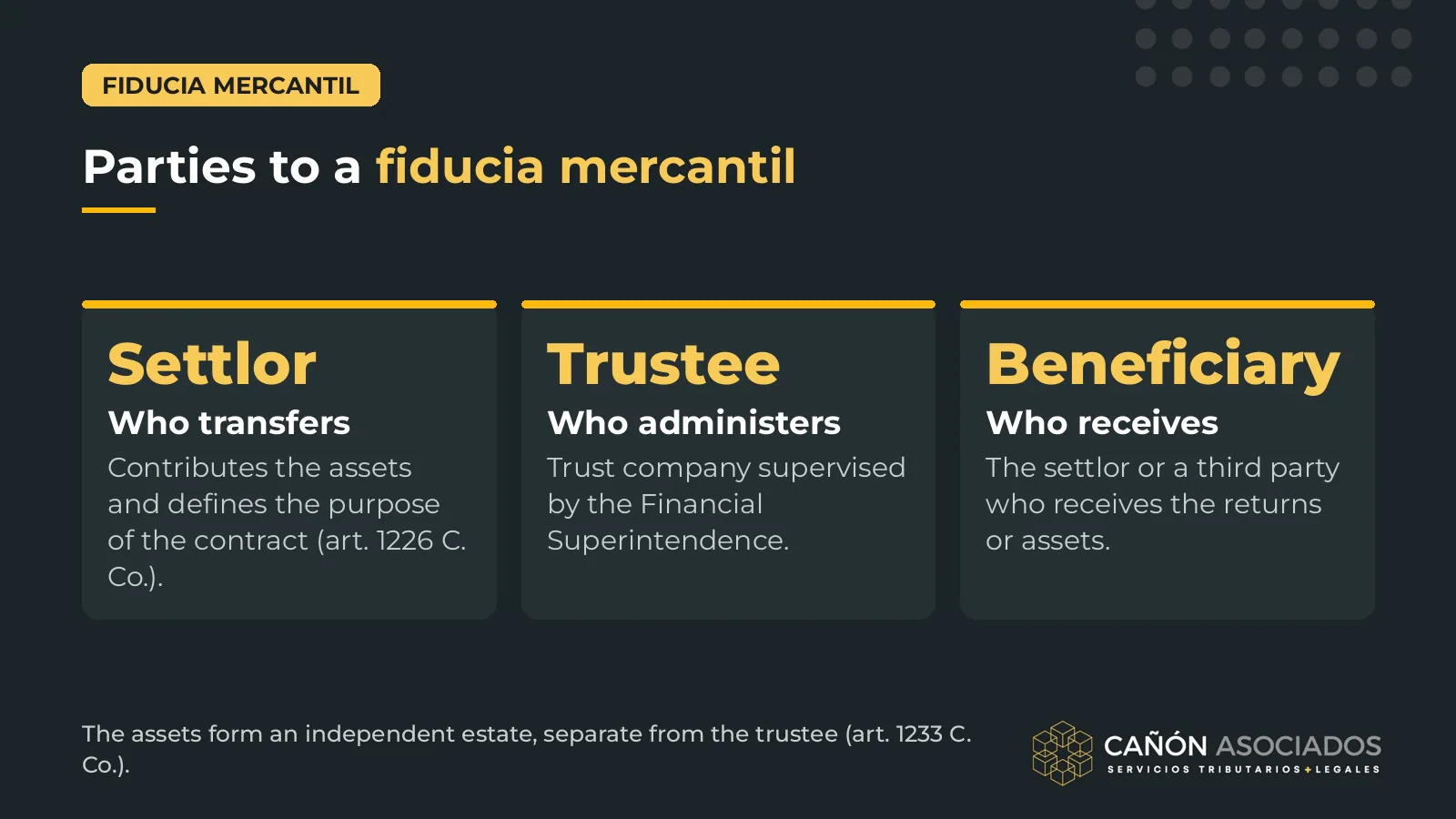
Three elements characterize it:
- The trustee is a supervised entity. Only trust companies and certain credit institutions authorized by the Financial Superintendence can act as trustees.
- An independent estate is created. The trust assets are kept separate from those of the trustee and of other transactions, and are dedicated to the purpose of the contract (art. 1233 C. Co.).
- The purpose is defined by the settlor. The contract sets out how the assets must be managed, who receives the returns, and what happens at the end.
It should not be confused with the encargo fiduciario (a fiduciary mandate), in which no ownership is transferred, nor with the civil fideicomiso or fiduciary ownership of the Civil Code (arts. 793 and following), which is a different figure.
How it is set up
A trust between living persons must be recorded in a public deed, registered according to the nature of the assets where the law requires it, as with real estate; a trust upon death must be set up by will (art. 1228 C. Co.). In practice, administration trusts over movable assets or cash are usually formalized by private document, which should be validated according to the assets involved.
Since Law 1328 of 2009, which repealed the former twenty-year limit, the term of the trust can be agreed freely. Secret trust arrangements, and those in which the benefit is granted to several persons in succession, remain prohibited (art. 1230 C. Co.), a restriction that is especially relevant in succession planning.
Uses of the trust in wealth planning
Protecting vulnerable beneficiaries
A trust can ensure that a minor child, a person with a disability or a dependent relative receives periodic funds managed by a professional, under rules set by the settlor.
Professional administration and continuity
Family properties, portfolios or shareholdings can be managed under clear instructions, preventing decisions from resting with a single relative or stalling in the face of disagreements.
Succession planning
The trust makes it possible to determine in advance the destination of certain assets, set conditions for their delivery (for example, reaching a certain age or finishing studies), and ease the transition. It can be set up during life or by will.
Essential limit: the trust cannot be used to override forced heirship shares (legítimas). Since Law 1934 of 2018, where there are forced heirs half of the estate is the strict forced share (art. 1242 CC), and transfers that affect it can be challenged by the forced heirs.
Protection against future risks
Trust assets cannot be pursued by the settlor’s creditors, unless their claims predate the setting up of the arrangement, and a trust entered into to defraud third parties can be challenged (art. 1238 C. Co.). The beneficiary’s creditors can only pursue the returns the beneficiary receives. That is why the trust is a legitimate protection tool when it is set up in advance, with assets of clear origin and without harming existing creditors.
Security and investment trusts
In business, the trust is also used to secure obligations, develop real estate projects or manage investment funds, which allows it to be built into the family’s overall structure.
Tax treatment of the fiducia mercantil
Article 102 of the Colombian Tax Code (Estatuto Tributario, or ET) sets out the main rules:
- Tax transparency. Beneficiaries include in their income tax return the income, costs and expenses of the independent estate, with the same nature they would have had if they had earned them directly.
- Tax cost. Trust rights keep the tax cost and tax conditions of the assets contributed. The transfer to the independent estate does not, by itself, generate tax for the settlor.
- Undetermined beneficiaries. Where the trust is subject to conditions that make it impossible to identify who the income beneficiaries are, the income is taxed in the hands of the independent estate at the corporate rate.
- Transfer to third parties. When assets or rights are transferred to persons other than the settlor, income or an occasional gain arises; if the transfer is free of charge, the tax arises in the hands of the beneficiary, under the rules for gifts.
- Net wealth tax. Trust rights are declared at the value of the underlying assets (art. 271-1 ET) and, for shares in Colombian companies, under the rules of article 295-3 of the ET.
For offshore structures, such as trusts or private interest foundations, article 295-3 of the ET provides that, for net wealth tax purposes, they are treated as trust rights and that the person who declares is the founder or settlor when the beneficiaries have no control over or power to dispose of the assets. These effects should be reviewed with our tax planning and consulting team.
Advantages and limitations
Advantages:
- Professional administration by a supervised entity.
- Separation of assets and clear rules on where the assets go.
- Flexibility to set conditions, terms and beneficiaries.
- Can be combined with companies, wills and family protocols.
Limitations:
- Trustee fees and set-up costs.
- It must respect mandatory allocations and cannot be used to defraud creditors.
- Prohibition of successive beneficiaries.
- It requires a carefully drafted contract: vague instructions create conflicts with the trust company or among beneficiaries.
Fiducia mercantil or family holding company: which to choose?
Both figures organize wealth, but they answer different needs. The family holding company is a company governed by the family itself, suited to concentrating ownership of businesses, making decisions at shareholders’ meetings and setting rules for share transfers. The fiducia mercantil hands administration to a supervised entity that must follow predefined instructions, which is especially useful when you want independence in administration, protection of vulnerable beneficiaries or precise conditions for delivering assets.
For many families the answer is not one or the other: it is common for the shares of a holding company to be contributed to a trust, or for a trust to be a shareholder of the family companies, combining corporate control with professional administration and continuity.
Recommendations before setting up a trust
- Define the purpose precisely and the beneficiaries, as well as the conditions for delivery.
- Compare the trust with other alternatives, such as a family holding company or a will with specific bequests.
- Review the impact on forced shares and on the marital or partnership property regime.
- Analyze the tax effects of setting up, holding and terminating the trust.
- Provide for governance mechanisms, such as trust committees, substitution of instructions and dispute resolution.
- Select the trust company considering its experience in wealth transactions and its fee structure.
How Cañón Asociados can help
In our family wealth management practice we structure fiducias mercantiles as part of comprehensive wealth and succession plans: we define their purpose, draft or review the contract, analyze their tax treatment and coordinate them with the family’s other tools. Through Integra Family Office we also support the monitoring and compliance of the structures implemented. Our managing partner, Carlos Andrés Cañón, is recognized by Chambers High Net Worth in Private Wealth Law – Colombia, and our wealth management practice is ranked by Leaders League.
Keep reading

Frequently asked questions
Who can be a trustee in Colombia?
Only trust companies and credit institutions authorized by the Colombian Financial Superintendence. An individual cannot act as trustee in a fiducia mercantil.
Does a fiducia mercantil protect my assets from creditors?
It protects against creditors whose claims arose after it was set up. Earlier creditors can pursue the assets, and a trust entered into to defraud third parties can be challenged (art. 1238 C. Co.).
Can a trust be used to leave assets to heirs?
Yes, during life or by will, but it must respect forced heirship shares. In addition, the law prohibits granting the benefit to several persons in succession.
How long can a fiducia mercantil last?
Law 1328 of 2009 repealed the twenty-year limit, so the term can be agreed freely according to the purpose of the arrangement.
How is a fiducia mercantil taxed?
As a general rule, under the transparency principle: beneficiaries declare the independent estate’s income as if they had earned it directly (art. 102 ET). Transfers to third parties can generate income or an occasional gain.
Is a fiducia mercantil the right tool for your family?
We help you assess whether it makes sense, how to structure it and how to integrate it with your wealth and succession planning.
- Chambers High Net Worth
- Legal 500 · ITR World Tax
- Leaders League · Best Lawyers
Contact our team directly
Carlos Andrés CañónManaging Partnercarlos.canon@canonasociados.com Carolina AcostaPartner, Legal Departmentcarolina.acosta@canonasociados.com
 Cañón AsociadosCalle 99 # 7A-77, Bogotá · contacto@canonasociados.com601 880 4462601 691 8313310 801 3324